tropicalbats.com
  • Home
  • Bats
  • Places of note
    • Suriname
    • Costa Rica
    • Norway
    • The UK >
      • London
    • The United States
  • critter essays
  • Birds
    • Suriname birds
  • tropicalbats blog
  • Coins: Errors, Varieties and Photography

It's rough out there - Snapping turtle (Chelydra serpentina)

6/18/2020

0 Comments

 
This common snapping turtle (Chelydra serpentina) was crossing the road from the swamp on the one side to the swamp on the other side as I was driving along just west of Port Austin, Michigan today.  

So I donated some blood to the local mosquito population to take a couple photos since he was just sitting there.  Turns out that he was a one-eyed turtle as his left eye looked much too damaged to see out of.  Yes, it's rough out there.
Picture
Common snapping turtle near Port Austin, Michigan
Picture
And it was a one-eyed turtle
0 Comments

Eastern Chipmunk (Tamias striatus) from near Port Austin, Michigan

6/17/2020

0 Comments

 
We have been finding that eastern chipmunks are nearly omnipresent in all the bits of forest in the "tip of the thumb" part of Michigan.  Here is one with its cheek pouches stuffed.
Picture
Eastern chipmunk (Tamias striatus) with cheeks full of food near Port Austin, MI
0 Comments

Red Fox (Vulpes vulpes) at the Huron County Nature Center Wilderness Arboretum in Port Austin, Michigan

6/16/2020

0 Comments

 
Had a little extra time today so went for a trail walk at the nearby arboretum.  While at the overlook this red fox wandered by and seemingly didn't notice me at all.  Fox here are seemingly quite common and always happy to see them.
Picture
A red fox (Vulpes vulpes) at the Huron County Nature Center Wilderness Arboretum
0 Comments

Eastern Gray Squirrel (Sciurus carolinensis)

11/18/2019

1 Comment

 
A short walk around Lake Accotink in northern Virginia was quite enjoyable, with many gray squirrels out and about getting ready for winter.
Picture
Eastern gray squirrel at Lake Accotink in northern Virginia
1 Comment

Sam the Eagle or Amb. William Taylor

11/13/2019

3 Comments

 
Okay, okay, I know Sam the Eagle isn't a real eagle, and this is quite a departure for this blog, but I was asked to create this little meme today so here it is.
Picture
3 Comments

Costa Rican Swamp Gas

5/13/2019

4 Comments

 
After studying The Cave of Death and all the carbon dioxide coming out of it, we were interested in any other places with such emissions.  Turns out Carlos knew of a gassy swamp, and so we decided to check it out.

Now most times you go slopping about in a swamp you get some gas bubbles coming up around your feet as the by-products of plant decomposition are released.  This is primarily methane and carbon dioxide with some hydrogen sulfide in the mix, created when plants decompose in the mostly oxygen-free zone under the swamp water.

But this swamp was quite different than anything we'd seen.  First, it is just a flat spot in the middle of a pasture that looks completely unremarkable other than one small pool of open water barely visible.

​.
Picture
Don and Carlos head down to the swamp, which extends as far as you can see to the right.
But once you start to head into it, the swampy nature becomes quickly noticeable.  Did you notice in the first photo that Carlos had on waders?  Well he would be the only one with dry feet after this bit.

We let Carlos go first, and it didn't seem bad at all.  He worked his way out into the weeds and didn't seem to be sinking in very far.  Oh this wouldn't be bad at all.
Picture
Carlos with the machete making a trail through the swamp
So McFarlane jumps at the chance to head in next, and just about when he catches up to Carlos he takes one step and drops through the grass matt up to his knees in water.  Huh?  Oh, didn't you know that a long time ago Carlos had laid boards through the swamp as a trail, but stepping a little left or right and, well, kabloosh.
Picture
Don showing us where the boards aren't
However, soon enough even Carlos lost the old board trail and it was slogging along trying to step on the grass hassocks and not find spots without a plant root mat.  Yes, we were in fact for the most part just walking on water.  The grass grew as a mat over the top and as long a we kept to the clumpy bits then we just sort of mushed along instead of sinking deep.
Picture
Slow and careful going across the grass mat covering the swamp water
At some point I realized that Guy had been quiet for too long and turned around to see him bemusedly trying to navigate the place while carrying a lot of electronic equipment and camera gear that would not enjoy it if he took a misstep and went in a deep spot.
Picture
Guy and the great swamp crossing with a load of non water-friendly gear
Finally, we arrived at the exact spot Carlos was trying to find.  He kept telling us to look for a funnel in the middle of the swamp, which made no sense.  Until we came across a giant funnel in the middle of the swamp.  An upside down funnel, but a funnel nonetheless.  
Picture
Carlos and Don reach the camouflaged funnel, which rises nearly 5 feet from the water's surface
Apparently since Carlos was here last, the vegetation had grown such that it completely covered the funnel.  And why, pray tell, is there a giant metal funnel out here?  Turns out Carlos himself put it here to capture swamp gas from a fixed surface area and then measure the flow out of the top to see just how gassy this swamp was.  Okay, that's pretty neat science, and a whole lot of hard work to put that thing out there.

We popped the lid off the tube at the top and could actually see the carbon dioxide gas coming out.  It's clear gas, but it looks a little bit like heat waves on a very hot day.  And it's pretty much pure carbon dioxide gas.  But wait...

Previously I noted that swamp gas is methane, carbon dioxide and hydrogen sulfide, and now I am saying that THIS swamp gas is 100% carbon dioxide.  Yes, and yes.  Because this swamp is located on the flank of the Poas Volcano, in a zone where carbon dioxide is super common in the subsurface, the swamp has become a sort of gas escape spot.  From what we could tell, very little gas in this swamp is from plant decomposition, while loads of it is from some effect of the nearby volcano.

Carlos chopped a hole in the grass near the funnel to show the water surface.  And it was just bubbling away!  This was cool.
Picture
Carbon dioxide gas bubbles right out of the swamp water
Okay, but this is just a large flat spot in a field, we couldn't be over more than a foot or two of water, right?  Carlos had more demonstration up his sleeve to show why it would be best to walk carefully.  He used a tripod with one leg fully extended.
Picture
Camera tripod at a hole cut through the swamp grass. Now you see it...
Picture
Now you don't
That's some deep water!  And we just were walking over it on the grass mat.  After this it did seem like everyone did walk ever more carefully though.

We left the swamp and Carlos told us about all the carbon dioxide in the area.  It seems that there is so much of it that they drill wells for it and capture it to use in pretty much every can and bottle of beer and soft drink in all of this part of Central America.  It's a lot of gas.  And on our way out of the area we did get to see one of the wells, which was our last quick stop before heading for dry footwear back at Recreo Verde.
​


Picture
A carbon dioxide gas well
And I hate to bury this very fun video at the end here, but this is something that Guy van Rentergem put together and is worth watching.  See the gassy swamp in action!
4 Comments

Cueva de la Muerte (Cave of Death) at Recreo Verde, Costa Rica

4/16/2019

32 Comments

 
The Cave of Death is not much of a cave, so to speak, but it is a really fascinating hole in the ground nonetheless.  Extending only about 10 feet into the hillside, it ends at a crack too small to continue.  That is, if it were reasonable to continue for other reasons.

Located on the flank of the Poas Volcano in Costa Rica, the Cave of Death just happens to be near some very nice hot springs which have been developed into Recreo Verde.  This fine place was our base camp, actually a fabulous cabin, for our work in this area.

And as for the cave, it is a bit of a tourist attraction, and probably one of the few commercial caves where one does not in fact go in the cave.  Why?  Good question and glad you asked.  The reason for the name is fairly simple, as the cave itself is a huge emitter of nearly pure carbon dioxide.  This, as one might suspect, is what could mildly be called, "bad air" and it is quite dangerous and often fatal to animals that enter the cave.

But, since carbon dioxide is heavier than air, the "bad air" is mostly along the floor, and in fact pools up at the entrance with the spillover rolling out of the cave and along the ground.  How do we know this?  Another good question!  Guy van Rentergem invented a clever little smoker device out of an e-cigarette machine, which could be placed in specific spots to see exactly where the gases were going.  As well, we used a carbon dioxide meter to determine where the gas was and in what concentrations.

​
Picture
Guy and his smoker tracking the flow of carbon dioxide out of The Cave of Death, Costa Rica
Note that the signs in the photo helpfully say "toxic gas", "entry prohibited" and "don't throw trash".  The last one is kinda funny, compared to the others, until you realize that any trash thrown in the cave is rather hard to retrieve since you can't just go in there and pull it out.

And just to be thorough, we tracked the gas with smoke all the way out of the protective barrier at the cave's entrance where it eventually drifts off in the breeze, while staying right along the ground.
​
Picture
Smoke-tracking the carbon dioxide coming out of the Cave of Death
And while Don McFarlane was taking a number of scientific measurements and recording data and just being an all around science guy...
​
Picture
Don McFarlane measuring gas concentrations at the Cave of Death
It still baffles me as to exactly what he was doing here...
Picture
Some stop and smell the roses, but Don McFarlane...
Anyway, one of the more notable features of the cave is the pool of carbon dioxide on the floor, which is remarkably stable, and nearly 100% CO2.  It is just deep enough that any small animals that go in there, end up in that oxygen-free zone and quickly pass out and die.  The Recreo Verde folks told us that the most common animals that die in the cave are rats, snakes and small birds.  And, just looking in we could see at least one fairly recent fatality (sorry, I can't get a species from this photo).
​
Picture
A dead bird on the floor of Cave of Death, Costa Rica
The smoke was really useful at showing the gas movement out of the cave, but what would it do when placed under the level of the carbon dioxide pool?  Man, you have all the great questions today!  Turns out that the gas has a very slow-moving eddy effect going on, and after a minute or two of watching the smoke it looked like a galaxy was forming.
Picture
Smoke shows the airflow pattern in the carbon dioxide pool in the Cave of Death
And just for an added attraction here at Tropicalbats.com, a video about the cave from none other than Guy van Rentergem!  

So that is the Cave of Death, a carbon dioxide-emitting hole that has a penchant for killing small animals.  And now I know you have one more question:  Did any of us actually go in there?  I end with this photo...
Picture
What sign?


***Huge thanks to Recreo Verde for allowing us to study their most interesting little cave.  Awesome place to stay on all accounts and really enjoyed it there.
32 Comments

Recreo Verde - Hot Springs

4/3/2019

0 Comments

 
We stayed at Recreo Verde when in this part of Costa Rica.  Nice place, with hot springs as the primary draw.  But we were there during the week so it was pretty quiet.

At one point it started to rain while a gentleman was cleaning the pool.  See, the hot springs lead to hot water pools where you can soak and relax (get wet).  But also next to them is a regular cool-water pool to jump in after all that heating up (another form of getting wet).

But now rain, apparently, is not an allowable form of getting wet.  Even when waist deep in the pool one requires an umbrella to stay dry (half getting wet).
Picture
In the pool with an umbrella at Recreo Verde
So, while Guy broke all tradition and hit the hot spring fully open to the elements (getting wet), Don was more traditional.  That is, if draping bubble wrap over your head is some local form of umbrella where he comes from (being all wet in another sense).
Picture
Don the bubble head with an amused Guy in the Recreo Verde hot springs
0 Comments

Aguas Zarcas Travertine Deposits, Northeast Costa Rica

3/27/2019

2 Comments

 
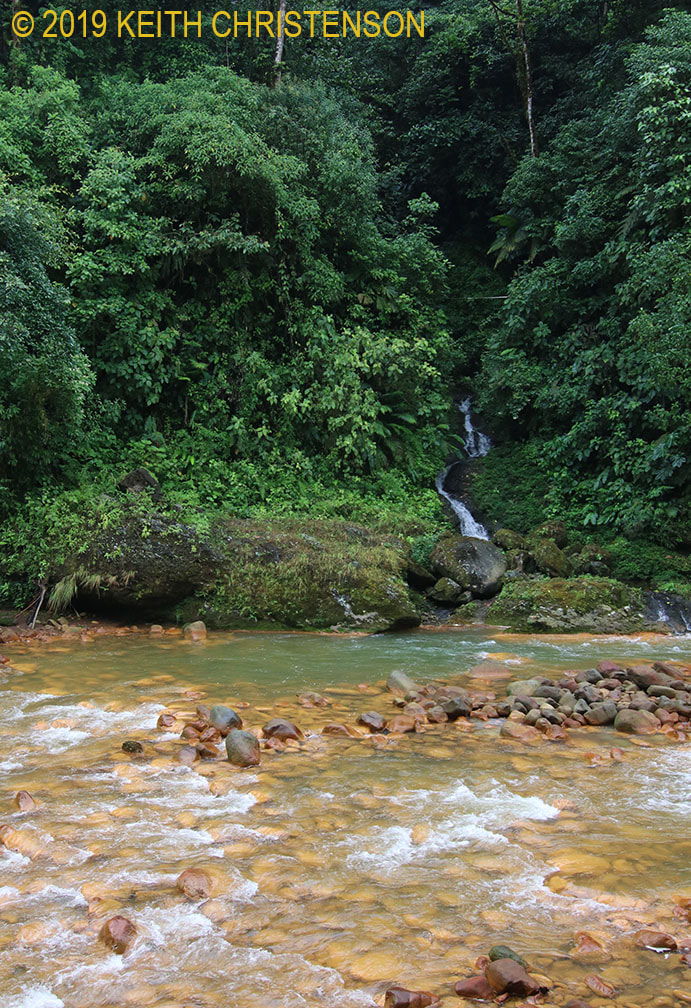
We left the Firestone Center and drove much of the way across Costa Rica to more or less the northeast from the southwest.  We ended up near the town of Aguas Zarcas on the Caribbean slope.  The name Aguas Zarcas is a bit hard to translate, but it is the type of water that comes out of mineral-laden hills and turns the river rocks an orangish color.  In coal mining country in the US this can be caused by acid mine drainage and is called red dog.
Picture
Aguas zarcas at the Recreo Verde hot springs
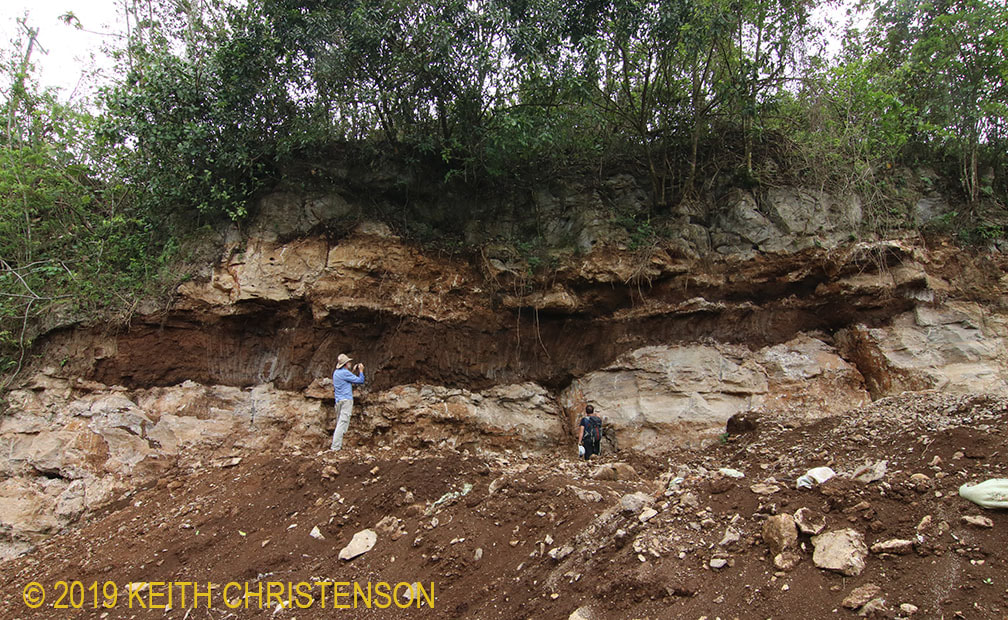
In this general area there are some significant travertine deposits.  Travertine is just another form of calcium carbonate (see limestone) and more or less looks like cave formations but right out there on the surface.  However, some of these deposits are quite thick, and here there is even a quarry mining the deposit to make fertilizer.
Picture
Highwall in a travertine quarry
In the photo above, what caught our attention was the soil layer in the stratigraphy.  Making a guess, and it is only a guess, the travertine was being deposited layer by layer, then a land slip covered it in soil, and then the travertine set about putting down more layers on top of the soil.  This would generally be called a paleosol, but not sure that exactly applies here.

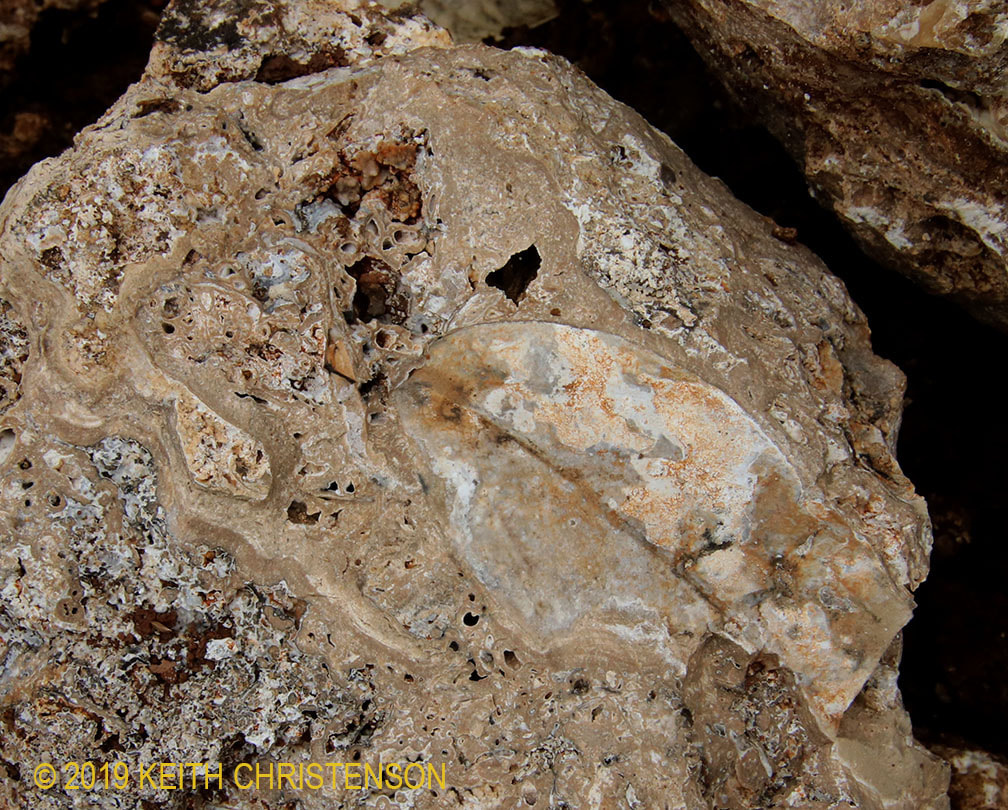
Also interesting is that the travertine deposits capture a lot of vegetation, and a variety of leaf imprints and such can be found in the rocks here.
Picture
Large leaf imprint in travertine
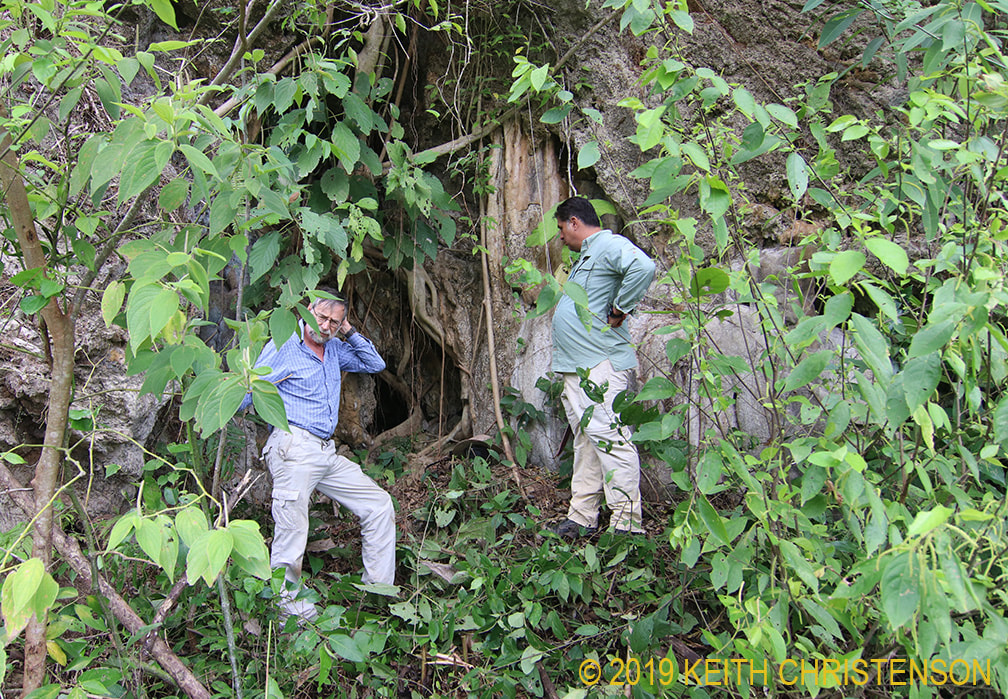
But what does this have to do with caves?  Well, travertine is soluble just like limestone, and our guide for the area, the eminent volcanologist Carlos José Ramírez Umaña, knew of at least one opening in the hillside.  We took a look, and although Don looks a little lost here, he eventually crawled in and found it to be a short cave.
Picture
Don and Carlos at the entrance to a short travertine cave
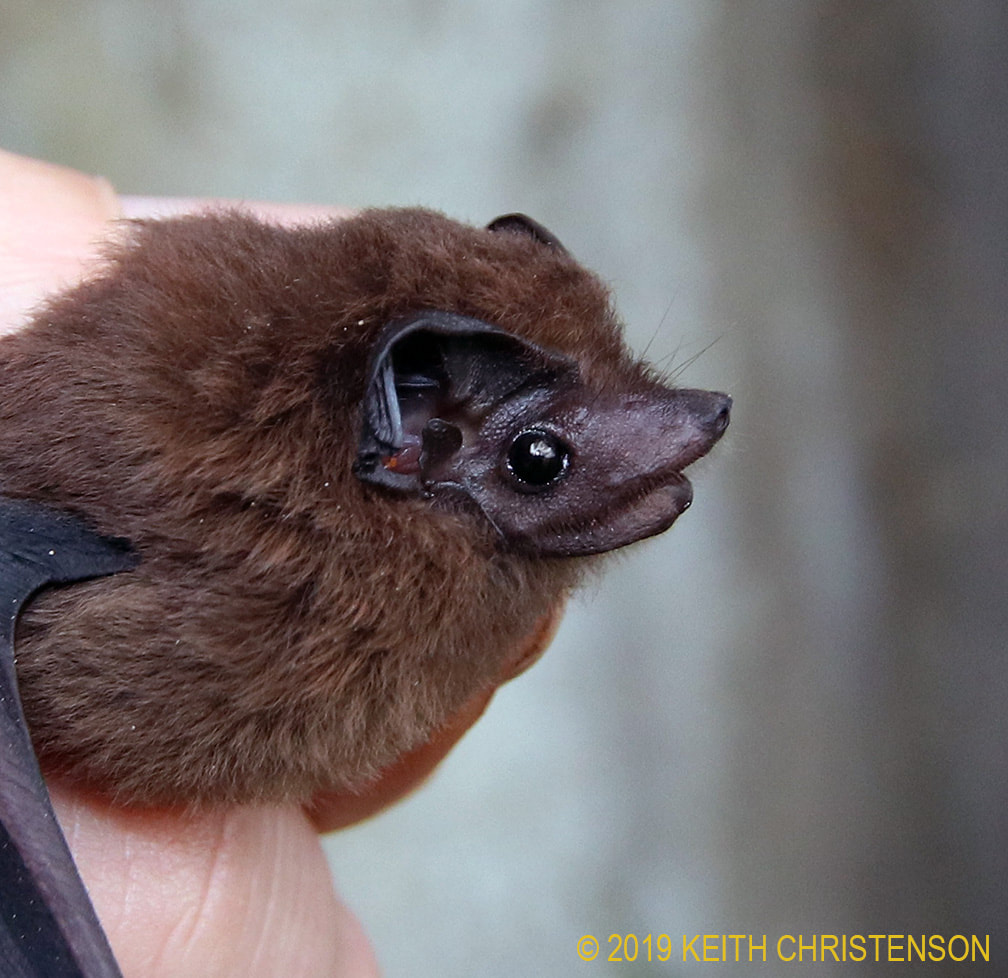
Nothing too much came from this, although a gorgeous lesser dog-like bat (Peropterx macrotis) was seen in there and so I had to get a quick photo.  These are tiny little insectivorous bats that top the scale at a whopping four grams, or less than the weight of two dimes.
Picture
Lesser dog-like bat (Peropterx macrotis) from a travertine cave in Costa Rica
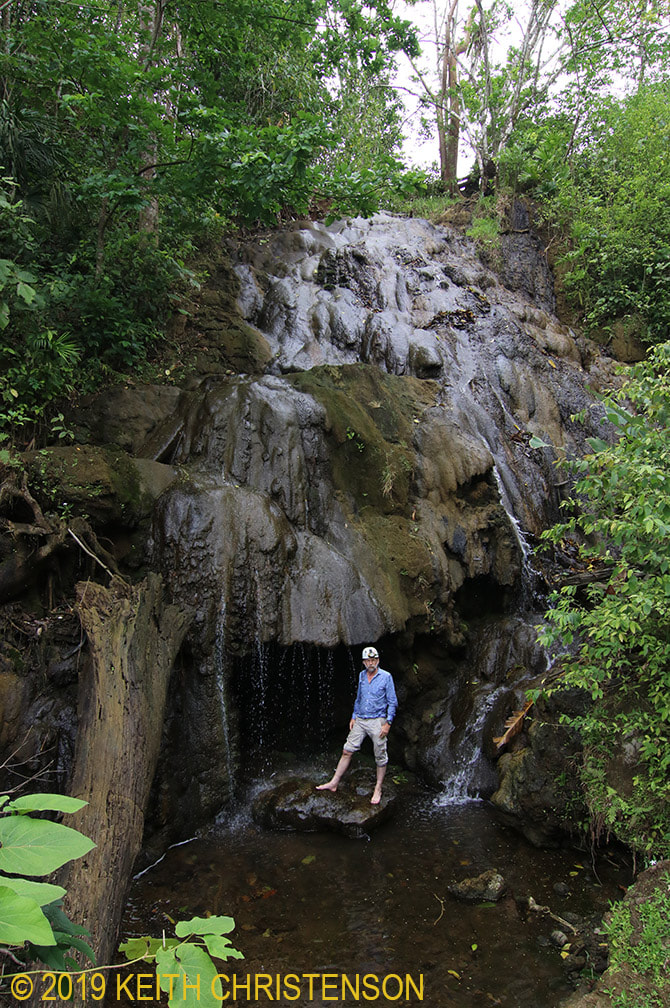
When looking for caves, it is often wise to follow the water.  Our first effort at doing this came up with a waterfall and what looks like a cave under there.  Turns out it was just a good place for Don to wash his feet, although really quite scenic.
Picture
Don at a travertine waterfall failing to find a cave entrance
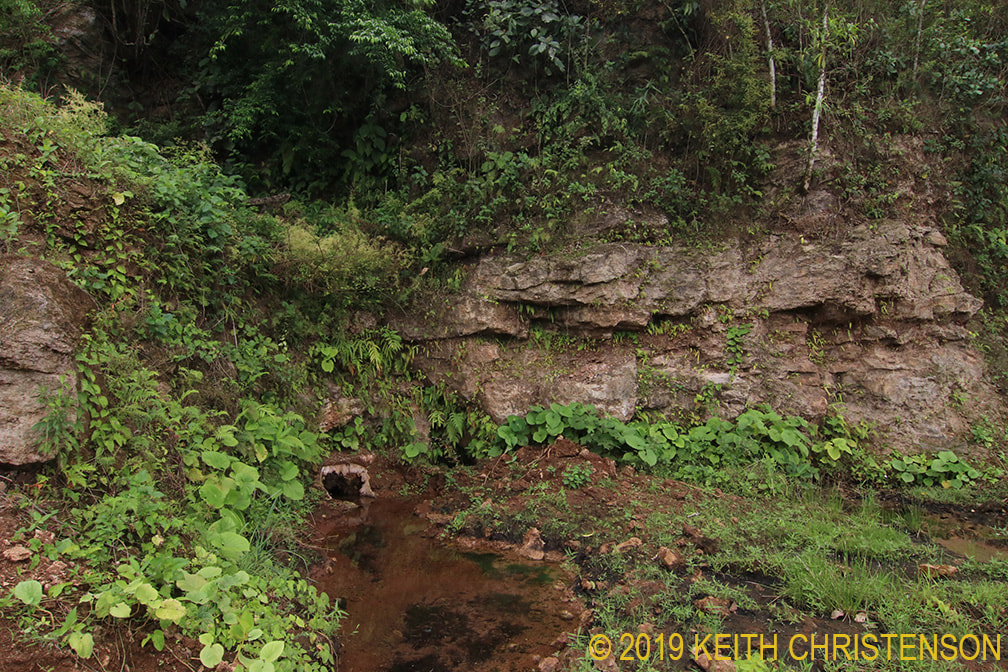
Our last bit was to check out a spring near the bottom of the travertine quarry highwall.  We thought this might have some potential, but the opening was far too small and although it moved a lot of water there was no airflow coming out.
Picture
Spring rising near the base of a travertine quarry
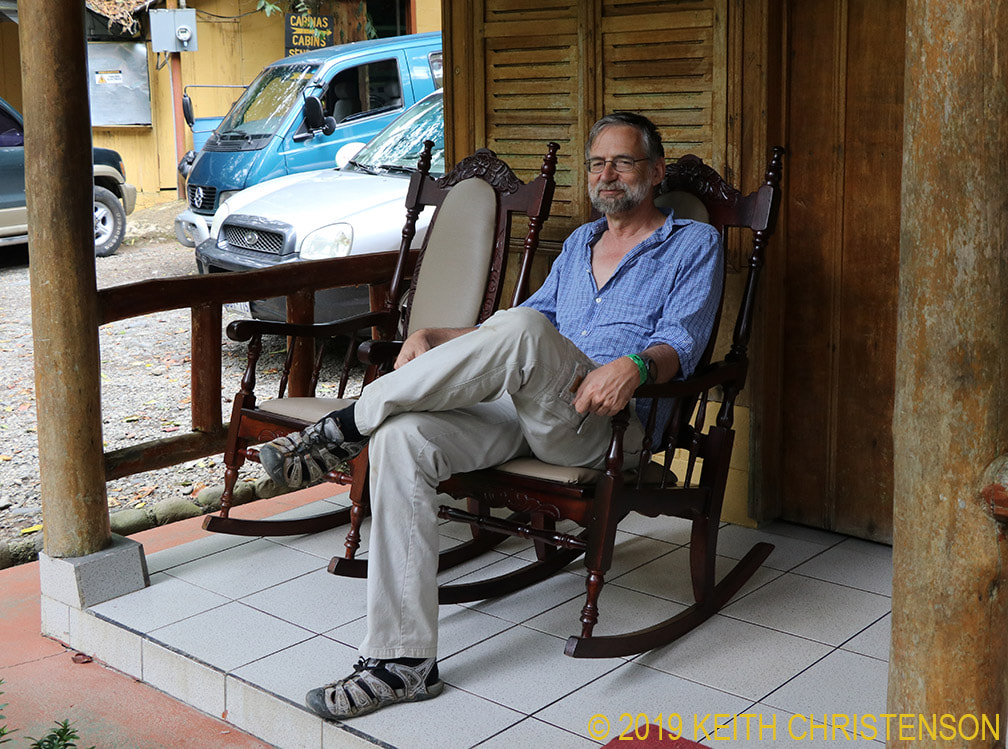
And after a fine day afield...
Picture
An old man in his rocking chair on the porch of Recreo Verde in Costa Rica
2 Comments

Firestone Center - Mosquito Trap and Wildlife on Our Transition Day

3/26/2019

0 Comments

 
After finishing up all our work with the bat and sea caves in the southwest of Costa Rica, we spent our last night in that region back at the Firestone Center.  Not the least of the reasons was for access to a washer and dryer, as another day and you'd know we were coming before we entered the room and know we had been there long after we left.  

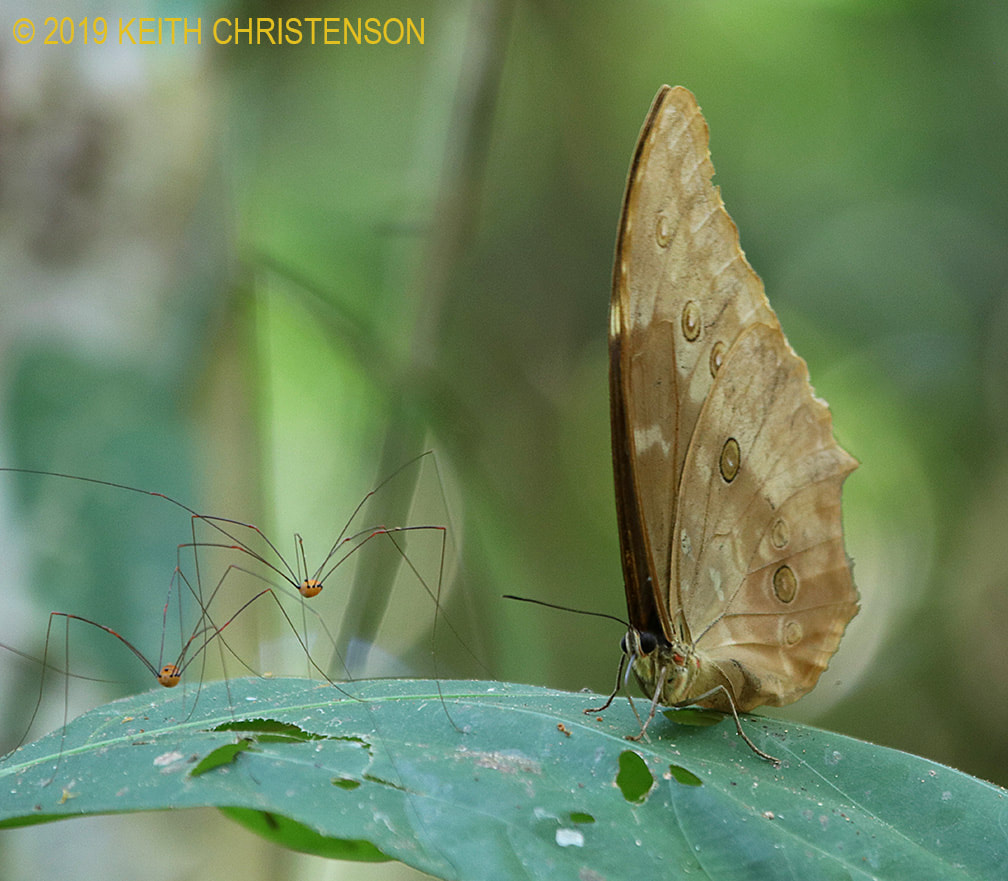
So here are a few more photos from the Firestone.  The first is an interesting scene on a leaf.  This blue morpho (Morpho sp.) was patrolling a trail when I saw it and I was able to follow it until it landed.  And when it landed the leaf was occupied by obvious predators of butterflies, harvestmen.  But I think in this case the butterfly would be just a little on the large size for these guys to go after.  Side note, the species of this butterfly is likely Morpho Menelaus, but the pattern is quite similar to Morpho didius which I do not believe to be found in Costa Rica.  Anyway, when they close their wings the blue disappears and they have the brown with eye spots pattern on the ventral side of the wings.
​
Picture
A blue morpho (Menelaus sp.) with harvestmen at the Firestone Center, Costa Rica
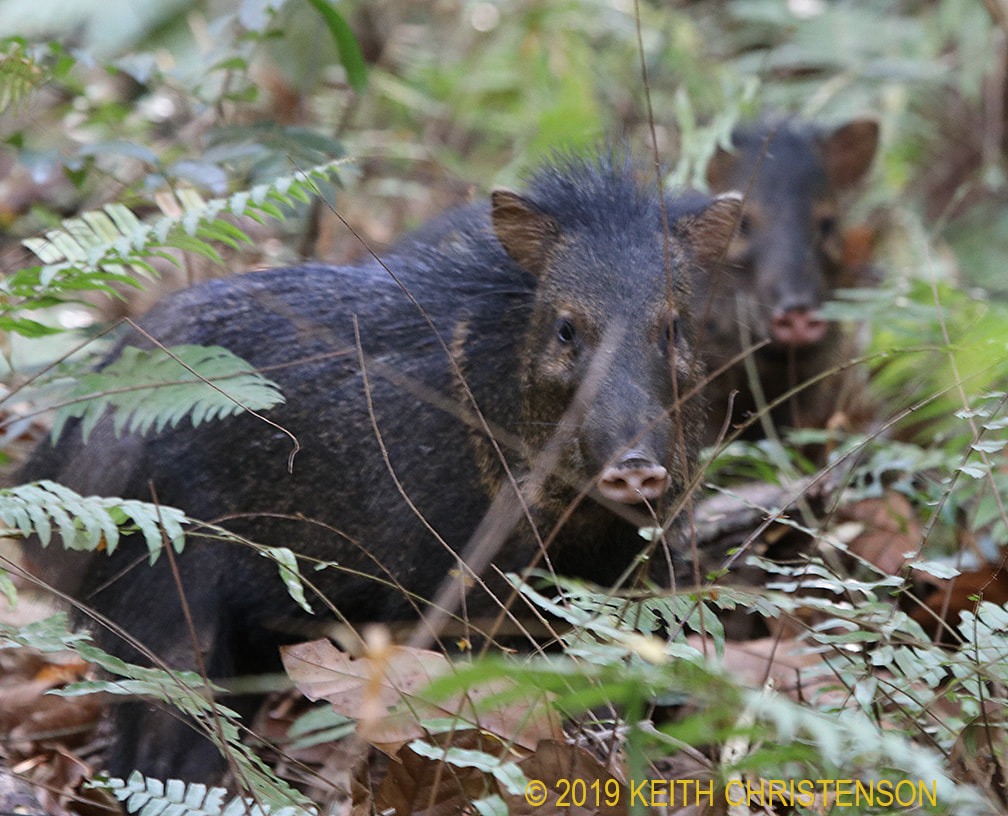
At the Firestone Center we have a lot of peccary.  They are notoriously near-sighted and even when pretty close can't seem to discern exactly what is going on unless you wave your arms or something.  But they also have a reputation for being grumpy leaning toward aggressive when you get too close.

I saw these collared peccary along the trail and they just kept getting closer and even when I was moving they just kind of shook their heads and didn't run off.  I took a photo and then took a little detour around them lest I get chased up a tree or something else less than heroic.
Picture
Collared peccary at the Firestone Center
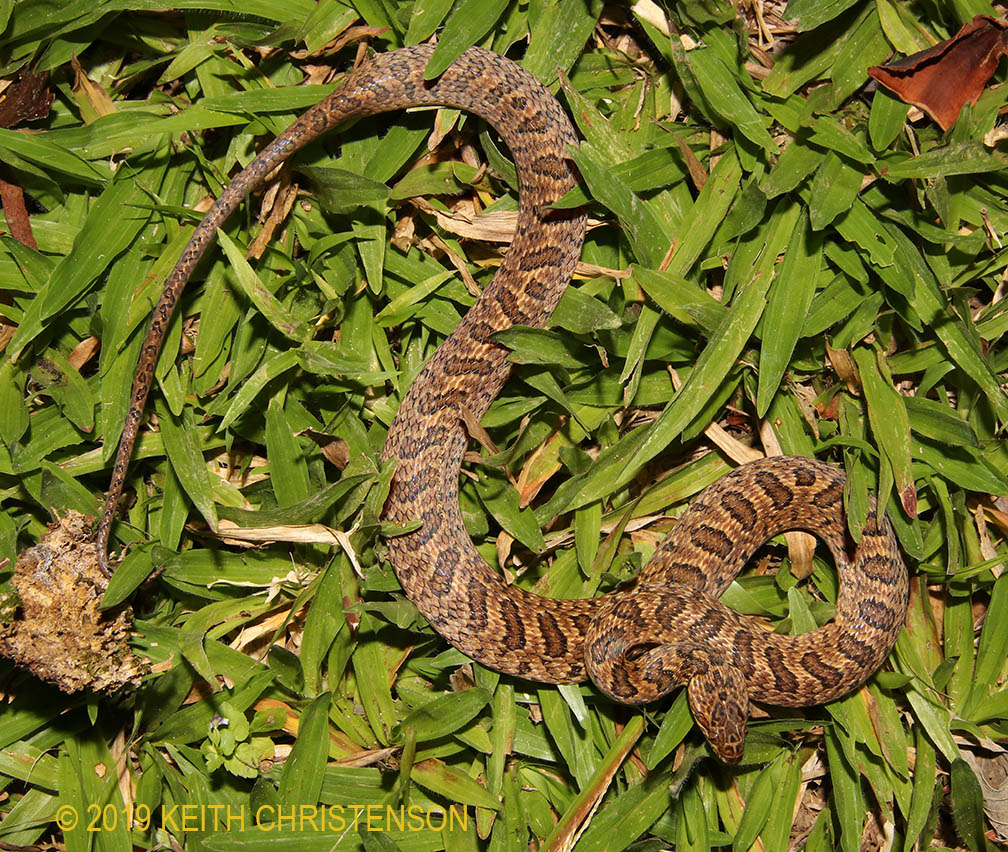
At night, I had to go into the forest to check on the mosquito trap.  It was hanging in a tree down by the Rio Cacao and pretty close to the Ecology Center.  On my way there, I spotted this Northern cat-eyed snake on the ground in the yard outside the Ecology Center.

They are fairly thin snakes, but when I got close it puffed itself up to probably more than twice its normal width.  And while not a dangerous snake, they are rear fanged and do have a venom, but even so you can pretty much pick them up and move them out of the way if needed.  Of note, this image looks a little odd since it was taken with the wide angle lens I had on my camera to photograph the mosquito trap.  I was only a few inches from the snake taking the pictures, which gives it an unusual look.
Picture
Northern cat-eyed snake (Leptodeira septentrionalis) outside the Ecology Cener at the Firestone Center for Restoration Ecology in Baru, Costa Rica
And finally, one of the things we have been working on at the Firestone Center is to figure out what mosquitoes we have and which species are in which habitats.  This has been a struggle as catching them in homemade traps hasn't been very successful.  

Here you see the latest model of the Dynatrap, a neat little thing that was a light and a fan (sucking inward) to attract and suck in mosquitoes.  The old model had to be plugged into an outlet, which unsurprisingly are not readily available out in the jungle.  This model was designed to work with an external battery, and early results are quite promising that this will be our go-to mosquito catcher in the future.
Picture
Battery-operated Dynatrap catching mosquitoes in the forest near the Rio Cacao.
0 Comments
<<Previous
Forward>>

    Author

    Keith Christenson - Wildlife Biologist

    Categories

    All
    Akershus Fortress
    Angry Baby
    Aurlandsfjord
    Bat Coins
    Bats
    Bird
    Birds
    Blast From The Past
    Borneo
    Butterfly
    Camouflage
    Caterpillar
    Caving
    Comets
    Costa Rica
    Crazy Video Links
    Crazy Video Links
    Cricket
    Cuba
    Denmark
    Dominican Republic
    Festivals
    Finse
    Fish
    Flower
    Flowers
    Folk Museum
    Freia Chocolates
    Frog
    Frogner Park
    Geese
    Goose
    Grønland
    Harvestman
    Hawaii
    Hedgehog
    Holiday Cards
    Huk
    Ice
    Insect
    Ireland
    Isopods
    Jamaica
    Kolsastoppen
    London
    Mammals
    Mexico
    Mourning Cloak
    Mushrooms
    Naeroyfjorden
    National Day
    Norway
    Ohio
    Oslo
    Oslo Opera House
    Oslo Summer Park
    Panama
    Patterns
    Pennsylvania
    People
    Pond
    Puerto Rico
    Roof Animals
    Scotland
    Sognsvann
    Spiders
    Spring
    Suriname
    United States
    United States
    Venezuela
    Virginia
    Washington Dc Area
    Washington Dc Area
    West Virginia
    Woodpecker
    World's End
    Zambia

    Author

    Keith Christenson
    Wildlife Biologist


    RSS Feed

    Archives

    September 2021
    May 2021
    February 2021
    November 2020
    August 2020
    July 2020
    June 2020
    November 2019
    May 2019
    April 2019
    March 2019
    February 2019
    October 2018
    September 2018
    August 2018
    July 2018
    June 2018
    May 2018
    April 2018
    February 2018
    January 2018
    December 2017
    November 2017
    October 2017
    September 2017
    August 2017
    July 2017
    June 2017
    May 2017
    April 2017
    March 2017
    February 2017
    January 2017
    December 2016
    November 2016
    October 2016
    September 2016
    August 2016
    July 2016
    June 2016
    May 2016
    April 2016
    March 2016
    February 2016
    January 2016
    December 2015
    November 2015
    October 2015
    September 2015
    August 2015
    July 2015
    June 2015
    May 2015
    April 2015
    March 2015
    February 2015
    January 2015
    December 2014
    November 2014
    October 2014
    September 2014
    August 2014
    July 2014
    June 2014
    May 2014
    April 2014
    March 2014
    February 2014
    January 2014
    December 2013
    November 2013
    October 2013
    September 2013
    August 2013
    July 2013
    June 2013
    May 2013
    April 2013
    March 2013
    February 2013
    January 2013
    December 2012
    November 2012
    October 2012
    September 2012
    August 2012
    July 2012
    May 2012
    April 2012
    March 2012
    December 2011
    January 2011
    November 2010
    October 2010
    June 2010

Proudly powered by Weebly
Photo from Evil_Prince